ABCD is an alternative to XYZ coordinate space – a different labelling system on pure Euclidean space that allows rationalization of a broader array of polyhedra, using rational trigonometry and vector algebra. The foundation was laid by Bucky Fuller, the math was developed by NJ Wildberger. This synthesis by Andy Thomson and his machine friends is ABCD.EARTH – a platform and software that is the culmination of a lifelong pursuit of a true, precise, synergetic architecture. Why EARTH? EARTH = Exploring Algebraic Rational Trigonometry Harmonically. Fuller’s Frequency isn’t metaphor, it is the claim that Universe’s structure is tunable at integer ratios, and that human minds (and now machine minds) can tune in by working in the coordinate system that speaks those ratios natively. ABCD integers are the harmonics. RT’s rational spreads are the tuning. This app is the instrument.
ABCD.EARTH is the home of ABCD.EARTH software – a 30yr project, starting originally as hand-coded ArchiCad GDL Polyhedra, and related experimental buildings. Thomson Architecture, Inc. has been the proponent of these projects, following in the footsteps of Buckminster Fuller, from non-orthogonal timber framed structures to the miniHome to Steel Quonsets, where we have often struggled with the accumulated error of conventional ‘distance and degree’ methods central to almost all CAD and BIM software.

Sometimes one software handles geometry well, but fails with drawings. Or it handles drawings well but is inflexible with geometry. In all cases however, machine precision is not expected in architecture, and so it is not built in to architectural software. On the many projects where we could try to put these methods into practice, the rotation, snap, placement and multiplication and array of non-orthogonal geometry has been clumsy and inefficient.


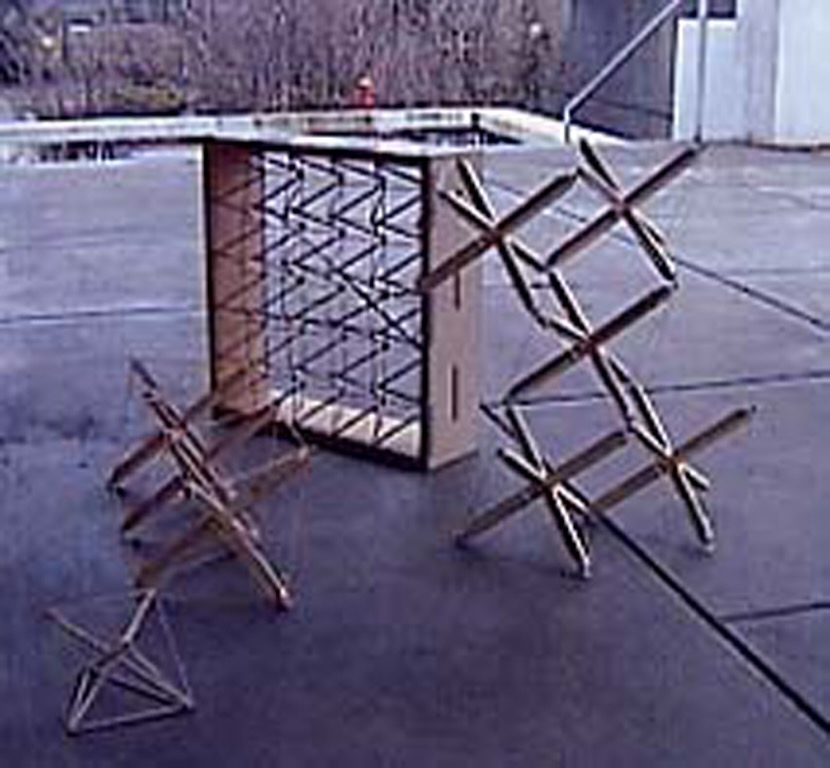

Andy has hand coded several solutions with degrees to 0.0000 four decimal places, in order to arrive at reasonable solutions for complex polyhedral structures, but still found many issues related to fabrication and assembly accuracy ultimately caused by accumulated error in the computational methods. With improved methods, Andy has been able to train agents in rational trigonometry and architectural detailing, to the point where building a complete specialized native Quadray-coordinate software using rational methods from scratch is within reach.
Built by a community of Humans with capable machine methods
ABCD.EARTH was developed through a collaboration between Andy Thomson and technical advisors and contributors and AI coding agents (currently Anthropic’s Claude via Claude Code). The project’s documentation system — CLAUDE.md, the Knowledge Graph (kg/modules.toml, a meta-cognitive graph built for agent traversal of the codebase using the 4D geometry of the app itself), and the Quadray Bible — is designed to be read by both human practitioners and AI agents. The codebase teaches itself to each new agent instance through structured handoff documents and a pre-commit hook that enforces RT-purity. The forward of the Quadray Bible, written by a Claude agent in April 2026, is the first AI-authored agent-to-agent letter in the project’s public materials.
The natural question: can AI-generated code be trusted? In this project, the geometry – a form of structured data answers for itself. A tetrahedron with integer Quadray vertices either closes or it doesn’t. A convex hull either produces the correct face count or it doesn’t. 1,107 unit tests either pass or they fail – there is no possibility for hallucination, AI wrote the code but does not participate in the app. The app renders every polyhedron in real time at 120fps to f64 or infinite (arithmetic) precision — you can rotate them, unfold them, dimension them, and verify the mathematics with your own eyes.
AI wrote the code; but the geometry is the proof.
ABCD.EARTH is an Apple OSX native app, written in Rust with Metal rendering. A Linux port is under consideration (with Vulkan).

The site walks through the canonical geometric approach step by step: tetrahedral coordinates, algebraic exactness (spread and quadrance instead of degrees and distance), and the tools that connect them. The goal is a rational foundation for CAD, BIM, and computational geometry — one that delivers more precise structures, simpler models, and in thousands of cases zero floating-point error.
Classical methods accumulate precision losses through trigonometric functions and Cartesian coordinates. ABCD eliminates them at the source.
The software can be used for nano-scale chemical and bio-molecular modelling, all the way up to architecture and astronomical scales, with f64 precision from math engine to clip space and screen pixel.
ABCD.EARTH did not develop in isolation. Its foundation is thousands of years of human observation, from:
- Ancient babylonian astronomers (our Quadrance demo shows intervals from the plimpton 322 tablet, dating back to 1800 BCE)
- to Kepler, Galileo – equal area swept in equal time, planetary orbits
- Newton – the ‘force’ equation behind Kepler’s observation
- Einstein – the implications of Newton’s formula on the shape of space
- Bucky Fuller and his associates – the actual coordinate system of Universe
- Kirby Urner, Tom Ace, the canonical relationship between XYZ and ABCD vectors (our ‘Normalizer’ engine)
- NJ Wildberger – how to work with these vectors, in both XYZ and ABCD algebraically and rationally often with whole integers.
- And many others, now extended with AI, parametric and machine learning methods.
Andy’s task with ABCD.EARTH has been to collect and synthesize of all of these ideas into a coherent codebase, useful for computational geometry and ultimately, the practice of a new kind of architecture, in harmony with the Earth and Universe.
